|
from Washington |
|
from Washington |
| A Wayward Buoy |
| Second Rotation |
| Fort Lewis, Monday, 12 January 2009: The Fort Lewis based Washington Army Reserve helicopter company departed for pre-deployment training in Oklahoma in preparation for it's upcoming mission in the Middle Eastern Theater. Best of Luck folks. |
| Rescue copter company heads home from Iraq |
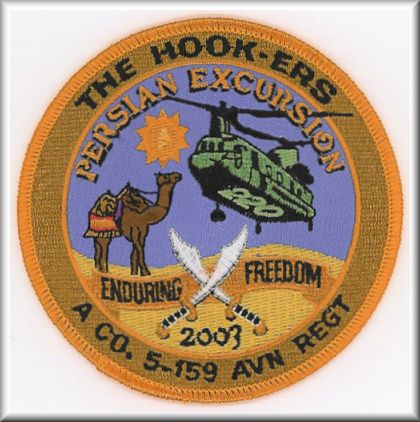
| Fort Lewis, Saturday, 17 April 2004: After 15 months away from home, a Fort Lewis-based Army Reserve helicopter company known locally for its high-altitude mountain rescues begins coming home Saturday. |
| At least 70 members of Company A - "Hook-ers", 5th Battalion, 159th Aviation Regiments are expected to arrive at Gray Army Air Field at Fort Lewis at 1 p.m. A second group of soldiers with the aviation company won't be home until May, however. |
| After their mobilization in January 2003, the soldiers were eventually stationed in Balad, Iraq, from which their CH-47D Chinook helicopters flew transport and supply missions. The 159th is part of the Army Reserve's 70th Regional Support Command, headquartered in Seattle at Fort Lawton in Discovery Park. |
| Anguish as Iraq tour extended again |
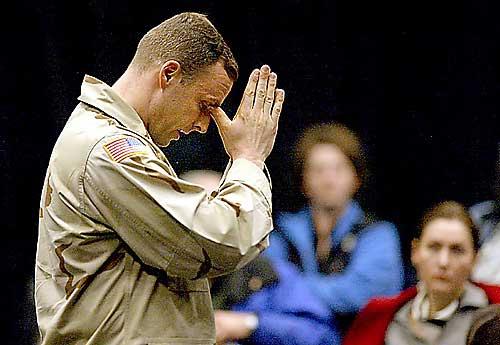
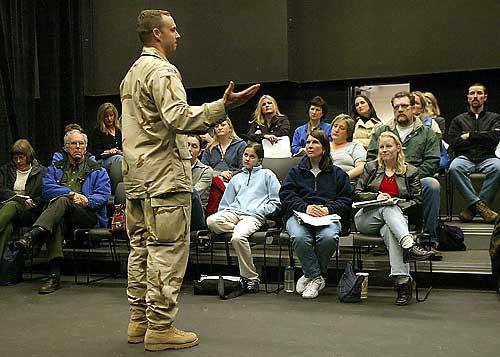
| Major Grant Haugen, commander of the Army Reserve unit, met this week with family members of soldiers in his unit to explain why their stay in Iraq has been extended for several more months. |
|
| Over the past 10 months, Major Grant Haugen's helicopter unit has ferried troops and equipment over central Iraq through bursts of gunfire and rocket-propelled grenade attacks, often guided only by the ghostly shine of night-vision goggles. But this week Haugen faced a rough mission on his own shores. |
| Back in the United States for a short leave, Haugen had the unenviable task of telling family members of his Army Reserve unit that its stay in Iraq had been extended for a third time. The news didn't sit well with nerve-worn relatives who were already counting the days until the unit's homecoming. |
| Alpha Company, a 200-member Chinook helicopter unit based at Fort Lewis, is among the first companies to have their tours in Iraq extended beyond one year. |
| Seven other units, mainly helicopter units in Germany and one Army National Guard unit from Illinois, also learned this week that their tours would go beyond 12 months. |
| The delays are needed to bridge the gap in service as the United States rotates nearly a quarter of a million U.S. troops to and from Iraq over the next few months, an Army spokesman said. |
| Necessary or not, some Alpha family members have become angry at the repeated extensions. |
| The company arrived in Iraq last March and was expected to return in November, then in March. |
| This week, the reservists and their family members learned they won't be coming home until May, more than 14 months after they left. |
| Major Grant Haugen returned to the area for a short stay so he could let loved ones know in person that the Army Reserve unit he heads will be staying longer in Iraq. It is the third extension for the Chinook helicopter unit based at Fort Lewis. |
|
| At family support-group meetings in Bellevue and Fort Lewis, Haugen faced a raft of upset spouses and other loved ones, whose raised voices sometimes turned on each other as some expressed support for the Army and others looked for someone to blame. |
| "We're just very frustrated," said Catherine Wells, 40, of Bellevue. "We've been given so many return dates already. Our fear is they're going to get extended again." |
| Wells' longtime boyfriend, Daniel Benke, a pilot in the unit, arrived in Iraq at age 41. He'll be 43 when he returns. |
| "Can you imagine that?" she said. "When you start thinking about it, it's maddening." |
| Haugen, 35, who in civilian life is a pharmaceutical representative in Kirkland, said the disappointment felt by family members was understandable. |
| "It's been a long time," he said, as his two young daughters clung to him. "And like these families, it kind of wears on you." But, he added, this is war, and the soldiers have their duties. |
| "It's not up to soldiers to question our orders," he said. "That's up to us as voters." |
| For some families, the extended stay will mean added financial hardships. The Army is working on a package to compensate soldiers for the extra duty that could include a cash bonus and other benefits. |
| Some family members complained that the long tour is weakening spirits and causing in-fighting among members of the unit. |
| "I'm not as concerned about their coming home later as some others," said Debbie Hart, whose husband is also a pilot. "I'm more concerned with morale." |
| Hart and others raised questions about the dangerous missions that the unit flies. |
| Stationed at an airbase in Balad, some 70 miles north of Baghdad, the unit has flown more than 1,000 missions, many over Sunni-dominated areas that have been the scene of the most intense clashes between United States and insurgent forces. |
| At least one Russian-made heat-seeking missile was shot at an Alpha Company helicopter, missing its target. And insurgents have tried several times, unsuccessfully, to bring down the unit's helicopters with machine guns and rocket-propelled grenades. |
| The missions took on a new level of danger after a Chinook flown by pilots from the Illinois and Iowa National Guard was downed on 2 November 2003 by a shoulder-fired missile, killing 16 soldiers. Since then, Alpha Company has been ordered to fly only at night and to turn off the position and anti-collision lights. |
| Night flying offers more security, but other dangers, even with night-vision goggles. |
| In e-mails home, some pilots and crew members have complained that they lack proper equipment, particularly modern missile-defense systems, and adequate training for night flying. |
| "The missile threat is lower, but the threat of flying into a sand dune or unlit tower at night is now extremely high, and most likely" said one pilot, whose wife shared his e-mails on condition that he not be named for fear of retaliation. "When and if this happens they (the chain of command) can say it was pilot error, not their hasty reactions and bad policy that will be to blame for the next tragedy." |
| At a meeting with about two-dozen family members this week in Bellevue, Haugen patiently listened to complaints and defended the missions. |
| He explained that in a region where mines, ambushes and homemade bombs have turned roads into deadly passages - flying troops and equipment by night is often the safest solution. |
| "It's a balance of risks," he said, adding that he analyzes each mission to ensure that the goal is worth the danger. |
| "Let's think about it like this," he said. "We all want to come home, but it would be a travesty for us to come home tomorrow if that meant another U.S. soldier died because we weren't there." |
| Haugen, who returns to Iraq next week, said the company also does whatever it can to keep up morale, including forming basketball and volleyball teams and holding pancake breakfasts on Sundays. |
| So far, Alpha Company has suffered no losses. While Haugen and some of the relatives had differences of opinions over risk, one thing they shared was the wish that, as the unit's tour is extended, so too is its luck. |
| Fun Runs in Iraq ? |
|
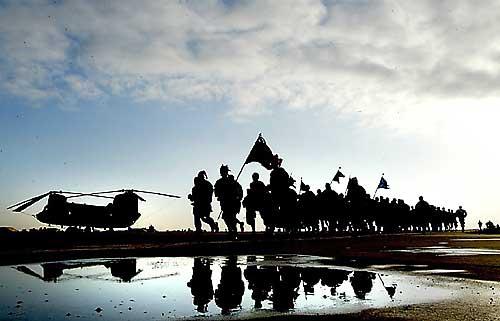
| 24 December 2003: Sliding past a parked Chinook, members of Alpha Company - "Hook-ers", 5th Battalion, 159th Aviation Regiment, United States Army Reserve - home based at Fort Lewis, Washington - participate in the Jingle Rock Run on Christmas Eve at the military base in Balad, Iraq. |
|
...sand among them |
| Fort Lewis, 24 March 2003 — They will be flying into the toughest conditions imaginable: blinding desert storms, engine-choking dust and grinding sands that devour rotor blades. |
| "Not to mention all that lead flying around," said Army Reserve Capt. Grant Haugen, Alpha Company commander with the 5th Battalion of the 159th Aviation Regiment. |
| The 214-member unit, which flies Chinook helicopters, made final preparations yesterday to depart for the Persian Gulf. |
| Among the last-minute details: a going-away ceremony. On any day, sending troops off to war is a tearful ritual for the family members who will stay behind. Yesterday's good-byes were all the more poignant, coming on the fiercest day of fighting in Iraq. |
| "Until now we've been glued to the television," said a red-eyed Kari Salkovics, 38, whose husband, Scott, pilots one of the unit's 14 helicopters. "Now I don't think I'm going to watch it at all." |
| The unit's giant Vietnam-era Chinooks will be used to ferry troops, artillery, ammunition and supplies. Haugen spoke bluntly of the dangers that range from engine malfunctions to midair collisions to "isolated terrorist attacks." Already, helicopter crashes — all due to accidents or mechanical failures — have accounted for most coalition deaths. |
| "There's a lot of great, wonderful things I get to stay up late at night worrying about," said Haugen, 34, who in civilian life is a pharmaceutical representative in Kirkland. |
| Hundreds of unit member spouses and children gathered for the ceremony, many drying tears with tissue. |
| For Diane Hurn of Olympia, it was the second time she has seen a loved one off to war. The first time it was her husband and it was Vietnam. This time it was a nephew she helped raise, 25-year-old Bobby Hurn, a unit mechanic. |
| "It doesn't get any easier," Diane Hurn said, adding with a breath of optimism that her husband came back unharmed, and so would her nephew. |
| "He has to," agreed Bobby's fiancée, Stephanie Gregoire. "He's got a wedding to attend." The date is set for May 23, 2005, which would be exactly five years after they met in the produce section of the Mega Foods in Tumwater. |
| About five members of the 114th Chaplain's Brigade and 20 with the 934th Medical detachment also took part in the ceremony and will deploy. |
| A handful of Alpha Company's pilots have combat experience, including the unit's oldest member. Chief Warrant Officer John Combs, 59, of Tacoma joined the company in 1970 after a tour flying UH-1 helicopters on combat assault missions in Vietnam. |
| "I feel a lot better about this war," he said. "I think it's more justified." |
| In peacetime, Alpha Company flies search-and-rescue missions on Mount Rainier and battles wildfires, among other missions. |
| The duties usually involve no more than a few craft flying far apart from each other. Preparing for Iraq, the pilots had to practice flying in tight formations. |
| Maintenance crews also trained for the extreme desert conditions they'll face, said Sgt. First Class Joseph Garcia of Lacey. Their greatest concern — apart from enemy fire — will be sand. |
| The Chinook's massive 40-foot rotor blades, each a yard wide, generate such wind the blades are blasted by swirling sand. It's the equivalent of putting a metal grinder to them, said one unit member. The crews will cover the blades with thick rubber tape to protect them in flight. They'll also continually wash the crafts to keep sand from eroding the engine and electronics. |
| Garcia intimated that some of the training will be on the job. "(Our crews) have been planning and training, but they're not as experienced as they are willing." |
| After yesterday's ceremony, he gathered his team members around him for some encouraging words and a final group photo to give to his church. "I just want my church members to be able to put a face and a name to the people out there," he said. |
|
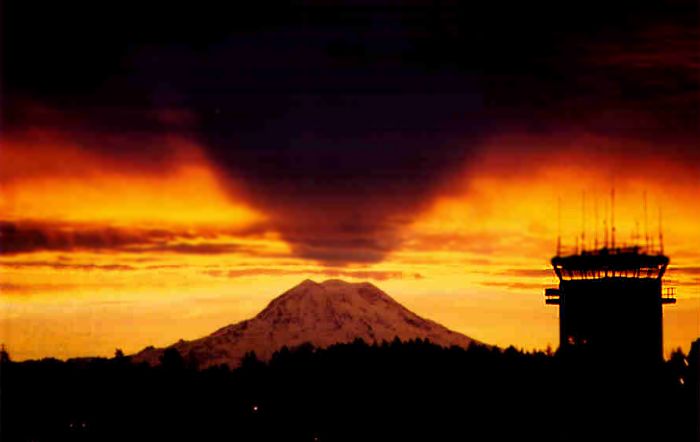
| Sunrise at Gray Army Airfield, Fort Lewis, Washington - 22 October 2002. |
| Washington Army Reserve |
|
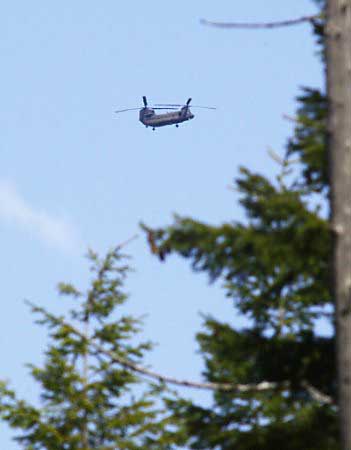
| An Army CH-47D Chinook helicopter, tail number 90-00221, assigned to Company A, 5th Battalion, 159th Aviation Regiment, United States Army Reserve (USAR) carries the bodies of two climbers off Mount Rainier, located in western Washington State, on 30 May 2002. The two victims, along with a third climber, died on Wednesday when a spring storm struck the mountain. A fourth climber managed to make it safely off the mountain. Two of the climbers are from Germany and the other is from Oregon, according to park officials. The recovery of the third body was postponed due to the lateness of the day and the inaccessibility of the area. |
| In a related story: On 6 June 2002, CH-47D Chinook 90-00207 was scheduled to launch on a Search and Rescue (SAR) training flight in the early morning. A call was received for a live rescue mission before the aircraft departed Gray Army Airfield, located at Fort Lewis, Washington. The crew flew to Kautz Creek and waited for approval to launch. Later that day, three rescued climbers were taken to Madigan Army Medical Center for treatment. Two of the three climbers intended to get married upon their arrival at the summit of Mount Rainier. |
| When 90-00207 returned to the parking pad, the aircraft was serviced and a new crew assigned. The helicopter then flew back to Kautz Creek to begin a second mission - to locate over due climbers. This mission became a recovery operation. The climbers bodies, Benjamin Hernstedt, 25, of Tigard, Oregon, and Jeffrey Dupuis, 21, of Big Flats, New York, were discovered from the air about 5:30 p.m. on Thursday, 6 June 2002 by the Chinook helicopter crew. Later that evening, 90-00207 and crew brought the bodies down off the mountain. |
|
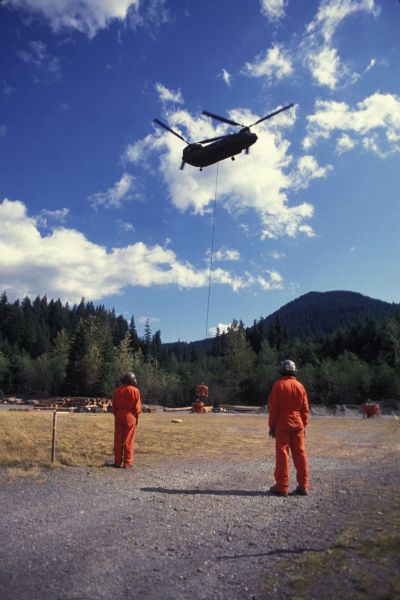
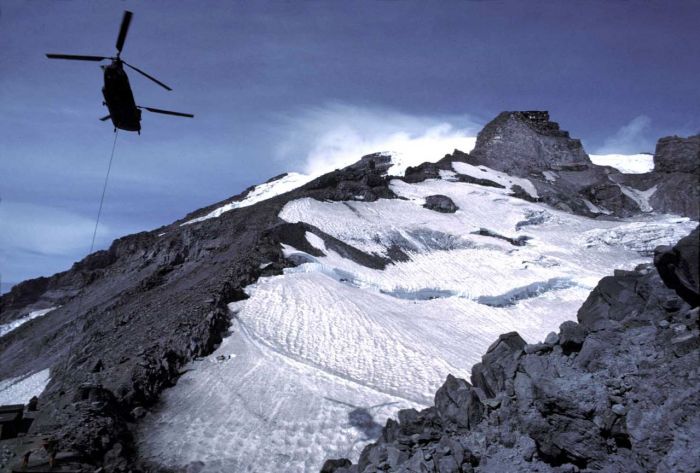
| A CH-47D from the U.S. Army Reserve located in the State of Washington conducts a gravel lift on Mount Rainier in August 1991. Click-N-Go Here to view a larger version of this image. CW4 Mike Jones write: "for over 17 years we had a very unique relationship between the Dept. of Defense and Dept. of Interior using our CH-47s to provide heavy lift support for Mount Rainier. Every Summer for 2 weeks, two Chinooks, and ground crews flew to Rainier and did some amazing flying. We'd typically haul over 4 million pounds of quarried stone, crushed gravel, log bridges, cement and anything else the small contract helicopters couldn't, in the 2 week work season. We built a heli-base on west side of the Park at Kautz Creek, shown above for staging out of . In the picture you can see the log area on the left. Logs were used to pre-build back-country cabins for Rangers, build foot bridges. On the right is the gravel pit. We used 1 and 2 yard construction buckets to pour gravel on high country hiking trails where Park ground crews would shovel it up and down the trail to control erosion. Most of our work was done under tactical conditions, with safety and production our primary goals. We worked at altitudes ranging from Kautz at 2200 feet clear to Rainier's 14,410 foot summit. We also flew many search and rescue missions on the mountain, some under extremely adverse conditions. I've landed Chinooks on areas just big enough for the 6 wheels, or just the aft 2 or hovering low enough to deploy a rescue team while blades turned a few feet from glaciers. One of our objectives and major selling point to the Army was the incredible training value of taking up green co-pilots and flight engineers and team them up with IP's and senior AC's to experience heavy lift, long line, high altitude flying. There is absolutely no place else in the world where this kind of training went on on a regular basis. As the trail crew boss for the Park Service once said "it is an amazing ballet of human beings and awesome flying machines." "Keep in mind that this was a 100% Warrant Officer creation from the bottom up. This didn't come down tasked to us. We invented it. We planned it. We flew it. And we managed it for 17 years and pretty much we were left alone. The operation was very safe with the only incident being a minor blade strike in a very cozy LZ once. I can't think of a more unforgiving place and a more magnificent place to fly. Simply breathtaking scenery all around you. " |
|
| A CH-47D from the Washington Army Reserve lifts a gravel bucket to facilitate the construction of a new helipad at the 10,000 foot level Camp Muir on Mount Rainier, August 1991. Click-N-Go Here to view a larger version of this image. |
|
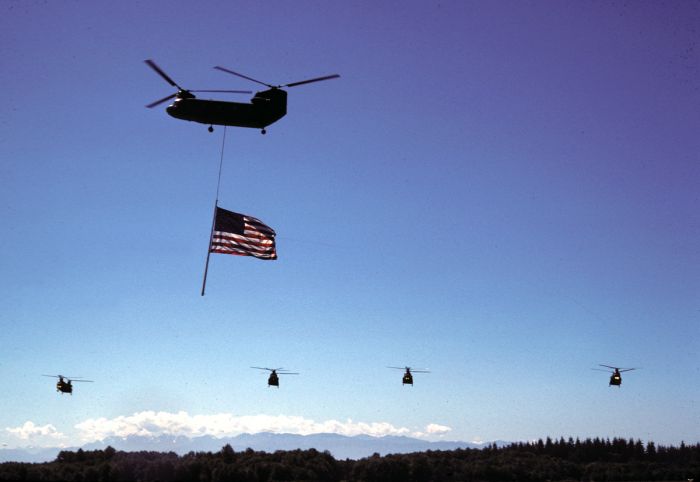
| CW4 Mike Jones writes: "Find attached a shot of me carrying a 20' x 40' American flag by our demo team at the conclusion of our 20 minute airshow demo. This was taken August, 1980 at the Paine Field Airfare. The flag was furled on the telephone pole and held in place by bungee cords. A parachute lanyard was attached to the bottom of the pole with another lanyard. Three smoke grenades were wired to the base of the pole. The top of the lanyard was wrapped around a spindle. The spindle was fitted over the shaft of a CH-47 windshield motor. The motor/spindle was attached to the top of the pole with power cords running up inside the Chinook. When the FE pushed a button, the motor would wind up the lanyard pulling it about 3 feet against the bottom bungee. In the process the pins were pulled on the smoke grenades and pins were also pulled on the bungees holding the wrapped up flag and hopefully, out came the flag and smoke trailed. It worked most the time, but we had a few misfires and later installed a manual pull cord if the motor didn't work. Very impressive and never failed to get the crowd on their feet cheering as Old Glory unfurled and fluttered in the 20-Kt breeze as we hovered down the crowd line." Click-N-Go Here to view a larger version of this image. |
|
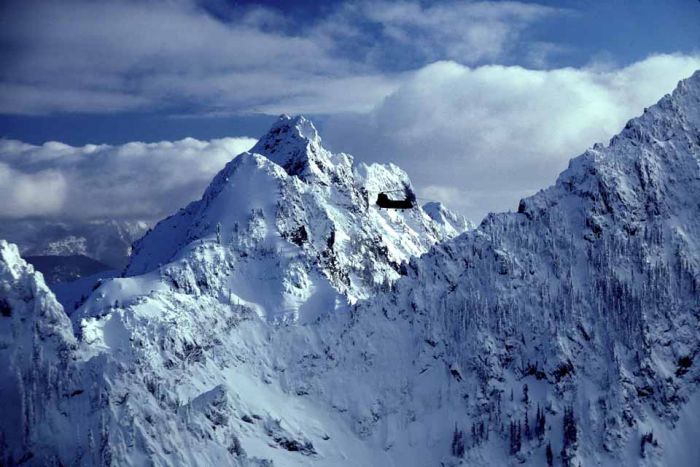
| CW4 Mike Jones writes: "A winter flight of 2 over the North Cascade mountains of Washington State. Taken January 1979. This is one of our A Models. We worked out a land-use agreement with Weyerhaeuser Timber company to use a section of the Cascade mountains for confined area, pinnacle and NOE training." Click-N-Go Here to view a larger version of this image. |
|
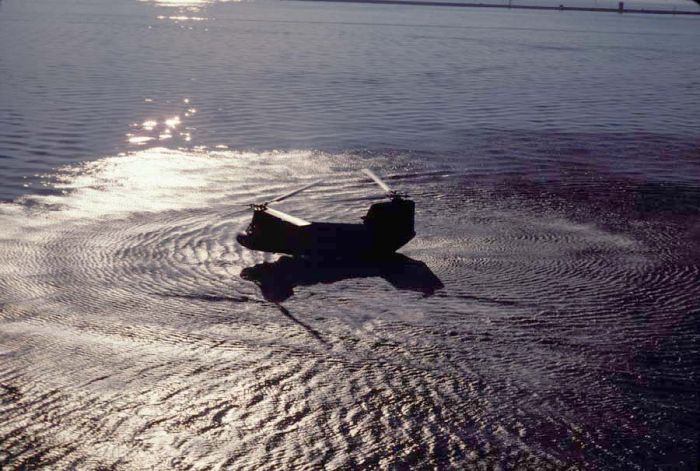
| An aircrew from the 92nd Aviation Company practices water landings on Lake Washington during their December 1978 drill period. Click-N-Go Here to view a larger version of this image. |
|
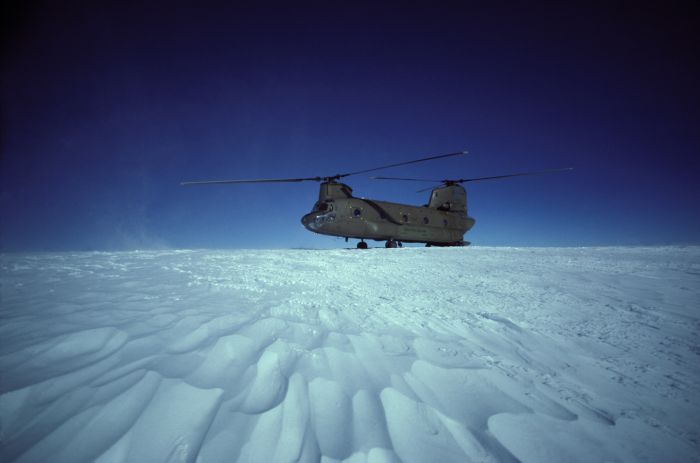
| 1978: An A model Chinook sitting on the top of Washington State's 10,778 foot Mount Baker. The mountain was used as a high altitude training LZ until it was later designated a Wilderness Area and off limits to further helicopter training. Click-N-Go Here to view a larger version of this image. |
|
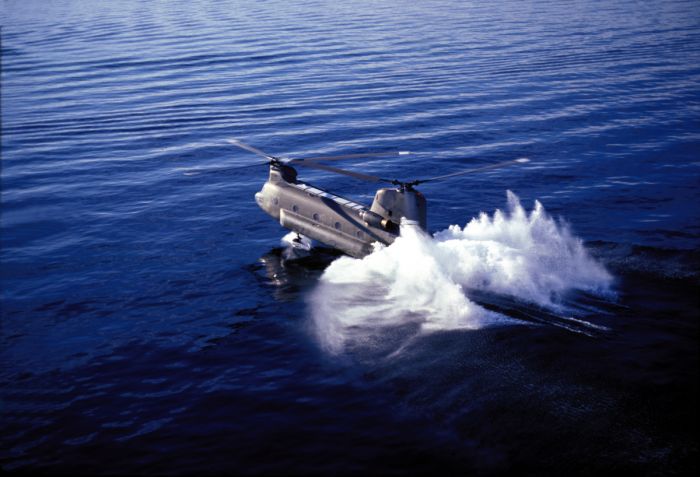
| 65-07980 conducts a run-on water landing on Lake Samammish just east of Seattle. Click-N-Go Here to view a larger version of this image. |
|
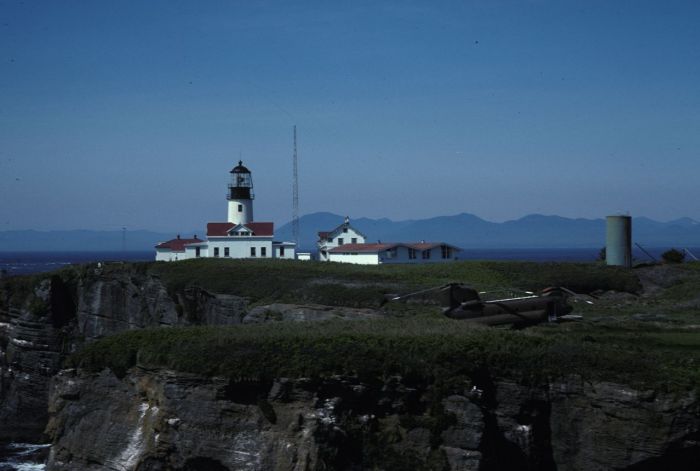
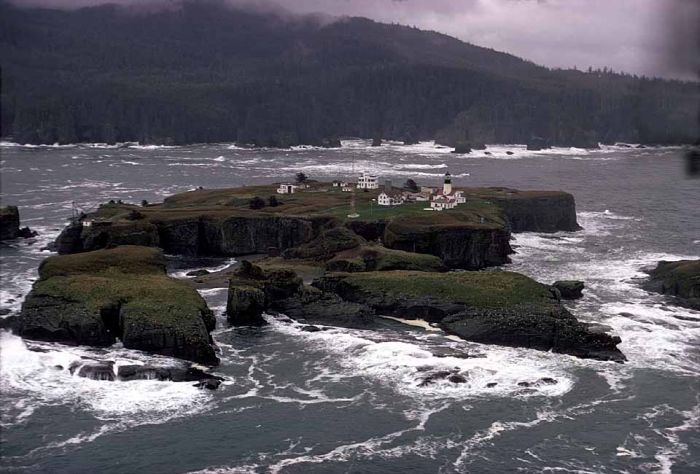
| An A model Chinook supports the United States Coast Guard on Tatoosh Island in Washington State. Click-N-Go Here to view a larger version of this image. CW4 Mike Jones writes: "1974, the Hook-ers begin a long relationship with the USCG starting with the restoration and automation of the light Station on Tatoosh Island at the entrance of the Straits of Juan de Fuca leading to Puget Sound and Seattle. Every summer we hauled debris off the island from the demolition of an old meteorological station, old water storage tanks, fuel tanks, old radio tower and the two buildings you see on the right side of the lighthouse. These were the lighthouse keepers residences. The island is extremely remote, located on the NW tip of Washington State. The 44-acre island and lightstation had been manned continuously from 1857 to 1974. The only way on and off the island is either by boat or helicopter. If by boat, you had to be lowered by crane (visible on far right) over the 120-foot cliffs surrounding the entire island into an awaiting 44 foot Coast Guard Cutter. Tricky business with the usual large ocean swell. So the wives were lowered by their husbands in the basket to the cutter below, then took the 5-mile boat ride to Neah Bay Coast Guard Station, got in old communal beat-up cars and drove sixty twisty miles to Port Angeles to shop, then turn around and reverse the process. Forget trips in the wintertime. Waves here can top the island's cliffs. The land you see behind is the south coast of Vancouver Island. The ocean is on the left side of the picture. This was some of the most rewarding flying I've ever done. The families were sure glad to see us come. We hauled everything, fuel, food, mail, Christmas trees, whatever they needed until it was closed and automated - a sad day." |
|
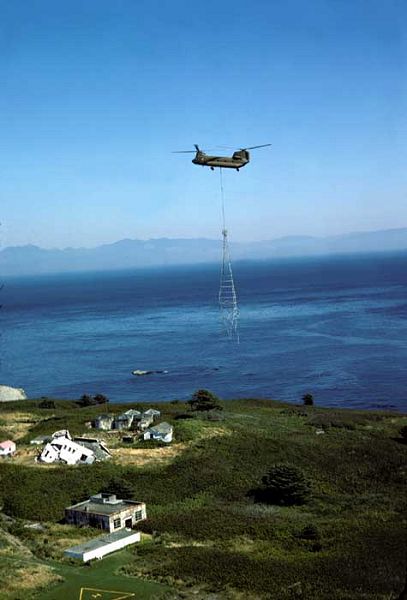
| A CH-47A Chinook removes the tower from Tatoosh Island. Notice that the old meterological station is now demolished. September 1975. Click-N-Go Here to view a larger version of this image. |
|
| CW4 Mike Jones writes: "April 1974. Tatoosh Island before automation. Access crane on far left, pump house and wooden water tanks next. The large white building was the old meteorological station, green diesel fuel tank and living quarters. The land behind Tatoosh is Cape Flattery, the very NW tip of Washington State. The channel between the headland and island is called Hole-in-the-Wall and is very rough when the tide is running and seas are up." Click-N-Go Here to view a larger version of this image. |
|
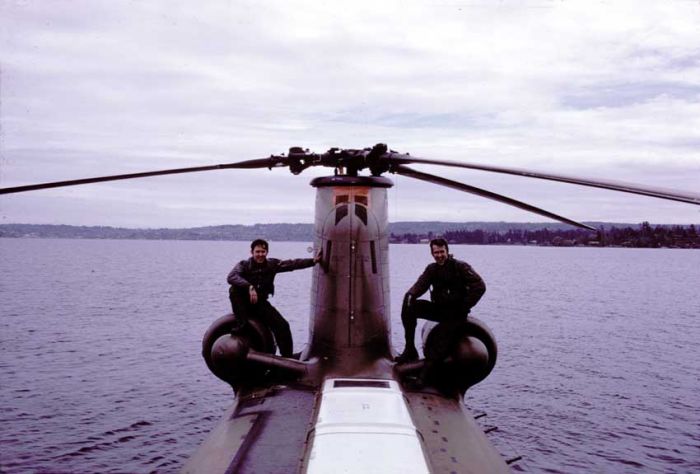
| CW4 Mike Jones writes: April 1974. We had just receive our first Chinooks a year before and being the adventurer types, we noticed a neat picture of a Chinook sitting in the water shut down in the -10. So, we tried it. First you have to install 27 drain plugs on the bottom of the Chinook and get the blessing of the maintenance department since doing this requires a wheel bearing repack. We only got away with this when a Chinook was going into 100-hour where they had to do the wheels anyway. Here you see me and Doug Houser not only testing the drain plug integrity, but the reliability of the APU to restart. We are sitting here stone-cold dead in the water on Lake Washington. We drew quite a crowd of weekend boaters. The police department also got flooded with phone calls from lakeshore residents that a 'big helicopter had crashed on the lake...' Just us having a little fun. Click-N-Go Here to view a larger version of this image. |
|
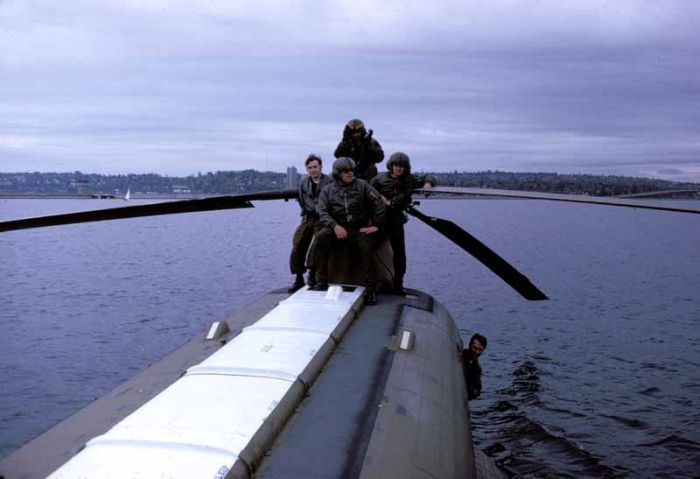
| CW4 Mike Jones writes: Whenever we got a Chinook to go play in the water, we usually had a large crew, here on the other end of the helicopter. See the Lake Washington floating Bridge in the background. I think Doug Houser and I have the most water time in the Chinook of anyone on the planet. We stayed in the water for about 20-minutes. It took quite a bit more power to hover when we initially came out of the lake since we took on a snoot full of water. The max time is 30-minutes. The Army's most expensive boat. ...would I do it again, well.......... maybe. I'd want the maintenance team we had taking care of that bird before doing it. We had our broom ready for a 'broom' start since we ended up tail to the wind. Click-N-Go Here to view a larger version of this image. |
| Related Sites |
| Postmarks (.pdf) |
| 90-00211 |
| Tail Number History |
   |
|
| Comments or Questions ? |  |
Email the Webmaster. |
|
|